
Northern Lights 30 Minute Forecast: Your Complete Guide to Predicting the Aurora in Real Time
Introduction
If you’ve ever dreamed of seeing the magical Northern Lights dancing across the night sky, timing is everything. While long-range aurora forecasts can give you a general idea of when activity might occur, they often lack the precision needed for successful viewing. That’s where the northern lights 30 minute forecast becomes incredibly valuable.
A 30-minute aurora forecast provides near real-time information about the likelihood of seeing the Northern Lights in your location. Instead of relying on predictions made days in advance, you can use live solar data and space weather updates to determine whether it’s worth heading outside within the next half hour.
Whether you’re visiting Iceland, Norway, Finland, Sweden, Canada, Alaska, or another aurora destination, understanding how a short-term forecast works can significantly improve your chances of witnessing this unforgettable natural phenomenon.
In this comprehensive guide, you’ll learn everything you need to know about the northern lights 30 minute forecast, including how it works, what factors affect its accuracy, the best tools to use, and practical tips for planning a successful aurora hunt.
What Is a Northern Lights 30 Minute Forecast?
A northern lights 30 minute forecast is a short-term prediction that estimates the probability of aurora activity over the next thirty minutes. Unlike forecasts that look several days ahead, these updates are based on live space weather observations.
The forecast continuously analyzes incoming solar wind data from satellites positioned between the Sun and Earth. Since these satellites detect changes before the solar particles reach Earth’s magnetic field, they provide approximately 30 to 60 minutes of advance notice.
This short warning period allows aurora enthusiasts to prepare cameras, travel to darker locations, and maximize their viewing opportunities.
Why It’s Different from Daily Forecasts
Daily forecasts focus on general geomagnetic conditions over the next few days. They are useful for planning trips but cannot predict exactly when the lights will appear.
A 30-minute forecast, on the other hand, offers:
- Near real-time updates
- More accurate short-term predictions
- Live solar wind monitoring
- Rapid changes based on space weather
- Better decision-making for photographers and travelers
Because aurora activity can change rapidly, checking a 30-minute forecast before heading outside is one of the smartest strategies.
Why Short-Term Aurora Forecasts Are More Accurate
Many people wonder why forecasts made only minutes ahead are often more reliable than predictions several days in advance.
The answer lies in the unpredictable nature of the Sun.
Solar eruptions, coronal holes, and fluctuations in solar wind constantly change as charged particles travel through space. Although scientists can estimate when these particles will reach Earth, their exact strength, speed, and magnetic orientation often remain unknown until they are much closer.
Once satellites detect incoming solar wind, forecasters gain much more reliable information.
That is why:
- Seven-day forecasts provide general expectations.
- Three-day forecasts offer moderate confidence.
- One-hour forecasts improve significantly.
- Thirty-minute forecasts deliver some of the highest accuracy available for aurora watchers.
How Does a Northern Lights 30 Minute Forecast Work?
Understanding the science behind aurora forecasting helps you interpret the information correctly.
Step 1: The Sun Releases Charged Particles
The process begins with the Sun.
The Sun constantly emits streams of charged particles called the solar wind. Sometimes it releases much stronger bursts through solar flares or coronal mass ejections (CMEs).
These particles travel toward Earth at speeds ranging from hundreds to over two thousand kilometers per second.
Step 2: Spacecraft Detect Solar Wind
Before reaching Earth, the solar wind passes monitoring satellites positioned roughly 1.5 million kilometers away.
These spacecraft measure:
- Solar wind speed
- Density
- Temperature
- Magnetic field direction
- Magnetic field strength
This information provides about 30–60 minutes of advance warning before the particles interact with Earth’s magnetic field.
Step 3: Scientists Analyze Incoming Data
Computers process millions of data points every minute.
They estimate:
- Aurora intensity
- Geographic visibility
- Geomagnetic activity
- Potential brightness
- Movement of the auroral oval
The results are updated frequently, making them much more accurate than forecasts created days earlier.
Step 4: Forecast Maps Update
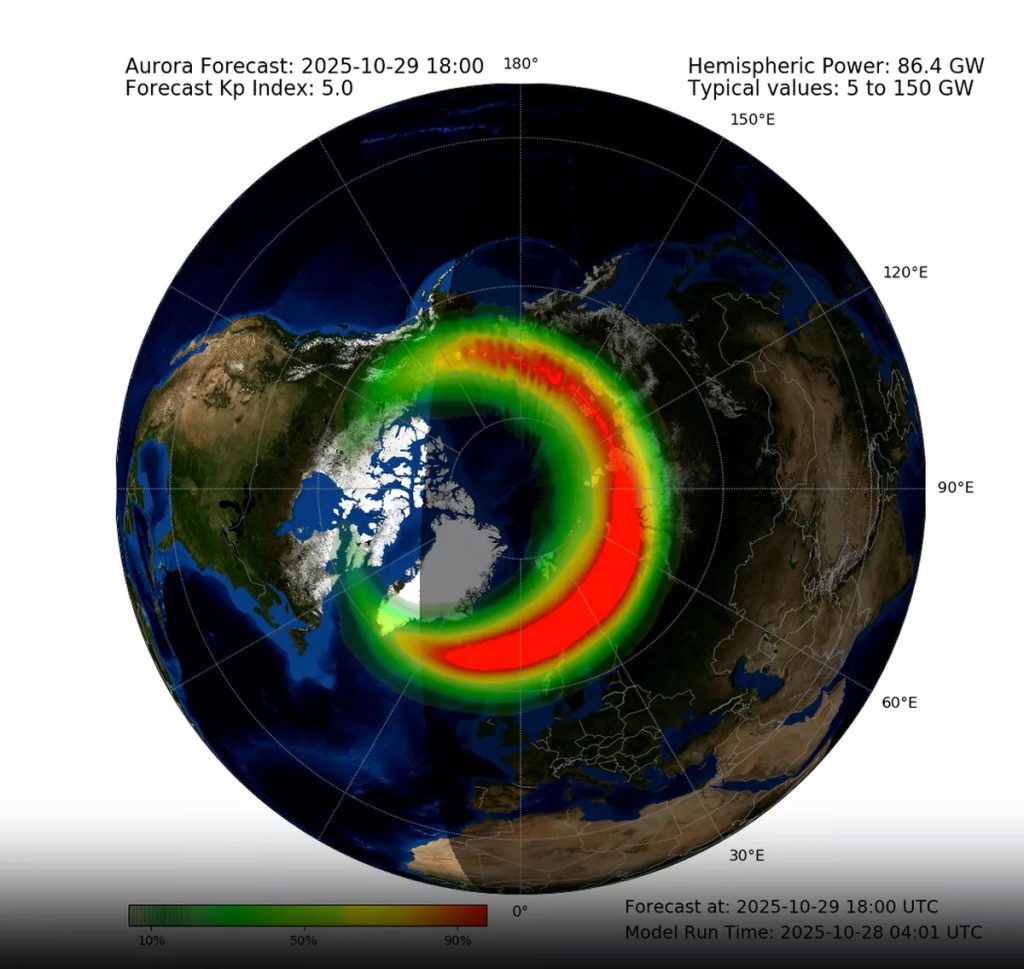
Most aurora websites display animated maps showing where the Northern Lights are likely to appear.
These maps often update every 5–15 minutes.
Colors usually indicate viewing probability.
Typical color scales include:
- Green = Low probability
- Yellow = Moderate activity
- Orange = Strong activity
- Red = Excellent viewing conditions
Understanding the KP Index
One of the most common numbers shown in aurora forecasts is the KP Index.
The KP Index measures disturbances in Earth’s magnetic field on a scale from 0 to 9.
Higher values generally mean stronger aurora activity.
KP 0–1
- Very weak activity
- Visible mainly in high Arctic regions
KP 2–3
- Common in northern Scandinavia
- Northern Iceland
- Northern Canada
- Alaska
KP 4–5
Auroras become visible much farther south.
Many travelers successfully observe the Northern Lights during these conditions.
KP 6–7
Strong geomagnetic storm.
Auroras may become visible across:
- Scotland
- Northern Germany
- Northern United States
- Southern Canada
KP 8–9
Major geomagnetic storm.
During rare events, the Northern Lights can appear across much of Europe and large parts of the United States.
KP Index Is Not Everything
Many beginners assume that a higher KP value automatically guarantees a spectacular display.
This is not always true.
Other important factors include:
- Cloud cover
- Moon brightness
- Solar wind speed
- Magnetic field orientation
- Local light pollution
A KP 2 night with perfectly clear skies may produce a better experience than a KP 6 night hidden behind thick clouds.
Solar Wind: The Heart of Every Aurora Forecast
The northern lights 30 minute forecast depends heavily on solar wind conditions.
Several measurements determine whether an aurora display will develop.
Solar Wind Speed
Faster solar wind generally increases aurora activity.
Typical ranges include:
- 300 km/s = Quiet
- 450 km/s = Moderate
- 600 km/s = Active
- 700+ km/s = Excellent potential
Solar Wind Density
Higher particle density means more charged particles striking Earth’s magnetic field.
This can strengthen auroras dramatically.
Magnetic Field (Bz)
The Bz value is one of the most important indicators.
When Bz turns negative, Earth’s magnetic field connects more efficiently with incoming solar particles.
A strongly negative Bz often produces brighter auroras.
IMF Strength
A stronger Interplanetary Magnetic Field (IMF) increases the chance of vivid auroral displays.
Forecast systems monitor this constantly.
Why Cloud Cover Matters
Even the strongest aurora cannot be seen through thick clouds.
Many people mistakenly blame the forecast when the real problem is weather.
Before chasing the Northern Lights, always check:
- Cloud cover percentage
- Fog
- Snowfall
- Rain
- Humidity
- Visibility
Combining weather forecasts with aurora forecasts greatly improves your chances of success.
Best Websites for a Northern Lights 30 Minute Forecast
Several trusted platforms provide reliable aurora forecasts and real-time space weather updates. Comparing information from more than one source can help you make better decisions before heading outside.
1. NOAA Space Weather Prediction Center
This is one of the most respected sources for aurora forecasts.
Features include:
- Aurora oval maps
- Geomagnetic storm alerts
- Solar wind data
- 30-minute forecast maps
- Space weather warnings
Many professional photographers rely on this information.
2. Aurora Forecast Apps
Many mobile apps provide:
- Push notifications
- Live KP updates
- Cloud forecasts
- Real-time aurora alerts
- Location-based predictions
These apps are especially useful when traveling.
3. Regional Aurora Services
Countries with frequent Northern Lights displays often operate dedicated forecasting services.
These regional forecasts usually combine:
- Local weather
- Cloud predictions
- Space weather
- Aurora visibility maps
They can be especially accurate for popular viewing destinations.
How to Read a Northern Lights 30 Minute Forecast
If you’re new to aurora hunting, forecast maps may look confusing at first. Once you know what to watch for, they become much easier to understand.
Pay attention to:
- The position of the auroral oval.
- Whether your location lies inside or near the active zone.
- Recent increases in solar wind speed.
- A negative Bz value, which often improves aurora potential.
- The latest cloud cover forecast for your area.
- Any geomagnetic storm alerts or rapid changes in activity.
Remember that conditions can change quickly. Refresh the forecast regularly, especially if you’re waiting for darkness or traveling to a viewing location.
Factors That Affect Forecast Accuracy
Although a 30-minute forecast is one of the most reliable tools available, it is still a prediction rather than a guarantee.
Several factors can influence its accuracy:
- Sudden changes in solar wind after the satellite measurements.
- Rapid shifts in Earth’s magnetic field.
- Unexpected cloud formation.
- Local weather changes.
- Light pollution from nearby towns or cities.
- Bright moonlight reducing the visibility of faint auroras.
Using both space weather data and local weather forecasts together provides the best chance of seeing the Northern Lights.
Best Time to Check a 30 Minute Aurora Forecast
Checking the forecast at the right time can save hours of waiting.
A good routine is:
- Review the general aurora forecast during the afternoon.
- Check the weather forecast before sunset.
- Begin monitoring the 30-minute forecast once it gets dark.
- Refresh updates every 10 to 15 minutes if conditions are changing.
- Be ready to travel to a darker location if the forecast improves.
Because auroras can brighten and fade within minutes, staying alert during periods of increased activity often leads to the best viewing experiences.
Best Places to Use a Northern Lights 30 Minute Forecast
A northern lights 30 minute forecast is useful anywhere the Aurora Borealis is visible, but it is especially valuable in destinations where weather conditions change quickly. Checking the forecast before leaving your accommodation can save time and increase your chances of seeing a spectacular display.
Iceland
Iceland is one of the world’s most popular destinations for viewing the Northern Lights. The weather can change rapidly, with clear skies turning cloudy in a short period. A 30-minute forecast combined with a cloud cover map helps travelers decide where to drive for the best viewing conditions.
Popular viewing locations include:
- Thingvellir National Park
- Vik
- Kirkjufell
- Jökulsárlón Glacier Lagoon
- Snæfellsnes Peninsula
Norway
Northern Norway is famous for its reliable aurora displays. Cities such as Tromsø, Alta, and the Lofoten Islands attract thousands of visitors every winter.
Using a short-term aurora forecast allows you to respond quickly when solar activity increases.
Finland
Finnish Lapland offers dark skies and excellent opportunities to see the Northern Lights. Areas around Rovaniemi, Saariselkä, Levi, and Inari are among the best places to watch the aurora.
Sweden
Abisko National Park is known for its clear skies and is often considered one of the best places in the world for Northern Lights viewing.
Canada
The Yukon, Northwest Territories, and northern Manitoba experience frequent aurora activity during the winter months. A 30-minute forecast helps visitors make the most of long nights.
Alaska
Fairbanks is one of the top aurora destinations in North America. Local weather can change quickly, making short-term forecasts particularly useful.
How to Increase Your Chances of Seeing the Northern Lights
Even with an excellent forecast, preparation matters. Follow these tips to improve your chances of success.
Choose a Dark Location
Artificial lights reduce your ability to see faint auroras.
Travel away from:
- City centers
- Streetlights
- Shopping areas
- Industrial zones
The darker the sky, the more vibrant the Northern Lights will appear.
Watch the Weather
Cloud cover is one of the biggest obstacles to seeing the aurora.
Check for:
- Clear skies
- Low humidity
- Good visibility
- Minimal fog
If necessary, drive to an area with clearer skies.
Be Patient
Auroras are unpredictable.
Sometimes they appear for only a few minutes.
Other times they dance across the sky for several hours.
Waiting patiently often pays off.
Dress for Cold Weather
Most Northern Lights destinations experience freezing temperatures during aurora season.
Wear:
- Thermal base layers
- Insulated jackets
- Waterproof boots
- Warm gloves
- A hat that covers your ears
Staying warm allows you to remain outside longer.
Photography Tips for Capturing the Aurora
A stunning aurora deserves an equally stunning photograph.
Use a Tripod
Long exposure photography requires complete stability.
A sturdy tripod eliminates camera shake.
Shoot in Manual Mode
Automatic settings often struggle in dark conditions.
Manual mode gives you complete control over:
- ISO
- Aperture
- Shutter speed
- Focus
Recommended Camera Settings
These settings provide a good starting point.
- ISO: 800–3200
- Aperture: f/1.8 to f/2.8
- Shutter speed: 5–20 seconds
- White balance: 3500–4500K
- Focus: Manual, set to infinity
Adjust the settings depending on the brightness of the aurora.
Use a Wide-Angle Lens
A wide-angle lens captures more of the sky and surrounding landscape.
This creates dramatic images featuring mountains, lakes, forests, or snowy landscapes beneath the aurora.
Include Foreground Elements
Interesting foreground objects add depth to your photographs.
Examples include:
- Trees
- Cabins
- Frozen lakes
- Mountains
- Reflections in water
Common Mistakes to Avoid
Many first-time aurora hunters make simple mistakes that reduce their chances of success.
Only Looking Overhead
The Northern Lights often begin as a faint glow near the northern horizon before moving overhead.
Scan the entire sky.
Ignoring Weather Conditions
A high KP Index is useless if thick clouds block the sky.
Always combine aurora forecasts with local weather forecasts.
Leaving Too Early
Aurora activity changes rapidly.
A quiet sky can suddenly explode with color.
Many displays occur after midnight.
Relying on One Forecast
Different forecasting services use different models.
Comparing several trusted sources provides a more complete picture.
Staying Near Bright Lights
Light pollution significantly reduces visibility.
Drive at least 15 to 30 minutes away from urban areas whenever possible.

Benefits of Using a 30 Minute Aurora Forecast
There are many advantages to checking a short-term forecast before heading outside.
These include:
- Better timing
- Less waiting in cold weather
- Improved photography opportunities
- More accurate predictions
- Faster response to changing conditions
- Greater chance of seeing bright auroras
Whether you’re a first-time traveler or an experienced photographer, a 30-minute forecast can make your aurora adventure much more successful.
Frequently Asked Questions
What is a northern lights 30 minute forecast?
A northern lights 30 minute forecast is a near real-time prediction that estimates aurora visibility during the next half hour using live solar wind and geomagnetic data.
How accurate is a 30 minute aurora forecast?
It is generally more accurate than forecasts made several days in advance because it uses current measurements from space weather satellites. However, local weather and cloud cover still play a major role in whether the aurora can be seen.
Can I see the Northern Lights with a low KP Index?
Yes. If you are in high-latitude regions such as northern Norway or Iceland, even a KP Index of 2 or 3 can produce beautiful auroras under clear skies.
What time are the Northern Lights usually strongest?
The best viewing period is generally between 9:00 PM and 2:00 AM, although displays can occur at any time during dark hours.
Do I need special equipment?
No.
You can enjoy the Northern Lights with your eyes alone.
However, photographers usually bring:
- DSLR or mirrorless camera
- Tripod
- Wide-angle lens
- Spare batteries
- Remote shutter release
Does the Moon affect aurora viewing?
Yes.
A bright full moon can make faint auroras more difficult to see, although strong displays remain visible.
Can clouds completely hide the Northern Lights?
Yes.
Even an intense aurora cannot be seen through thick cloud cover, making weather forecasts just as important as aurora forecasts.
Are free aurora forecast apps reliable?
Many free apps provide useful real-time information, especially when combined with official space weather data and local weather forecasts.
READ MORE:
Final Tips for Aurora Hunters
If seeing the Northern Lights is on your bucket list, preparation is key. Here are some final recommendations:
- Check the northern lights 30 minute forecast before leaving.
- Monitor cloud cover throughout the evening.
- Choose locations with little or no light pollution.
- Keep your camera ready with charged batteries.
- Dress warmly for extended periods outdoors.
- Stay patient, as aurora activity can change quickly.
- Continue checking the forecast every 10–15 minutes during periods of high activity.
These simple habits can dramatically improve your chances of witnessing an unforgettable aurora display.
Conclusion
A northern lights 30 minute forecast is one of the most effective tools for planning a successful aurora viewing experience. By using live solar wind data, geomagnetic activity, and local weather information, these short-term forecasts provide timely insights that help travelers, photographers, and outdoor enthusiasts make informed decisions.
Although no forecast can guarantee an aurora display, combining a reliable 30-minute forecast with clear skies, dark viewing locations, and patience greatly increases your chances of success. Whether you’re exploring the icy landscapes of Iceland, the fjords of Norway, the wilderness of Canada, or the snowy forests of Finland, understanding how to interpret real-time aurora forecasts can turn an ordinary night into a once-in-a-lifetime experience.
The next time you plan an aurora adventure, make checking the northern lights 30 minute forecast part of your routine. It could be the difference between missing the show and witnessing one of nature’s most breathtaking spectacles.